
For the past decade, data leaders have been asked to pick a side. Warehouse or lake. Lake or lakehouse. Snowflake or Databricks. Batch or streaming. These debates consume a remarkable share of executive attention, and they matter less than they appear to.
Compute is becoming a commodity. Storage on S3 is cheap, durable and increasingly shared between engines through open table formats. Every major platform can now run large SQL workloads at scale. What has not become a commodity is trust: the confidence that the number on the dashboard is the number in the ledger, that it is current, and that it will still be right after the next failure, migration or re-platform.
Trust is not created by the platform you buy. It is created, or quietly destroyed, in the ingestion layer, the unglamorous code that decides which rows changed and how they arrive. In our experience, most “the warehouse is wrong” incidents, most runaway compute bills, and most stalled migrations can be traced back to that layer.
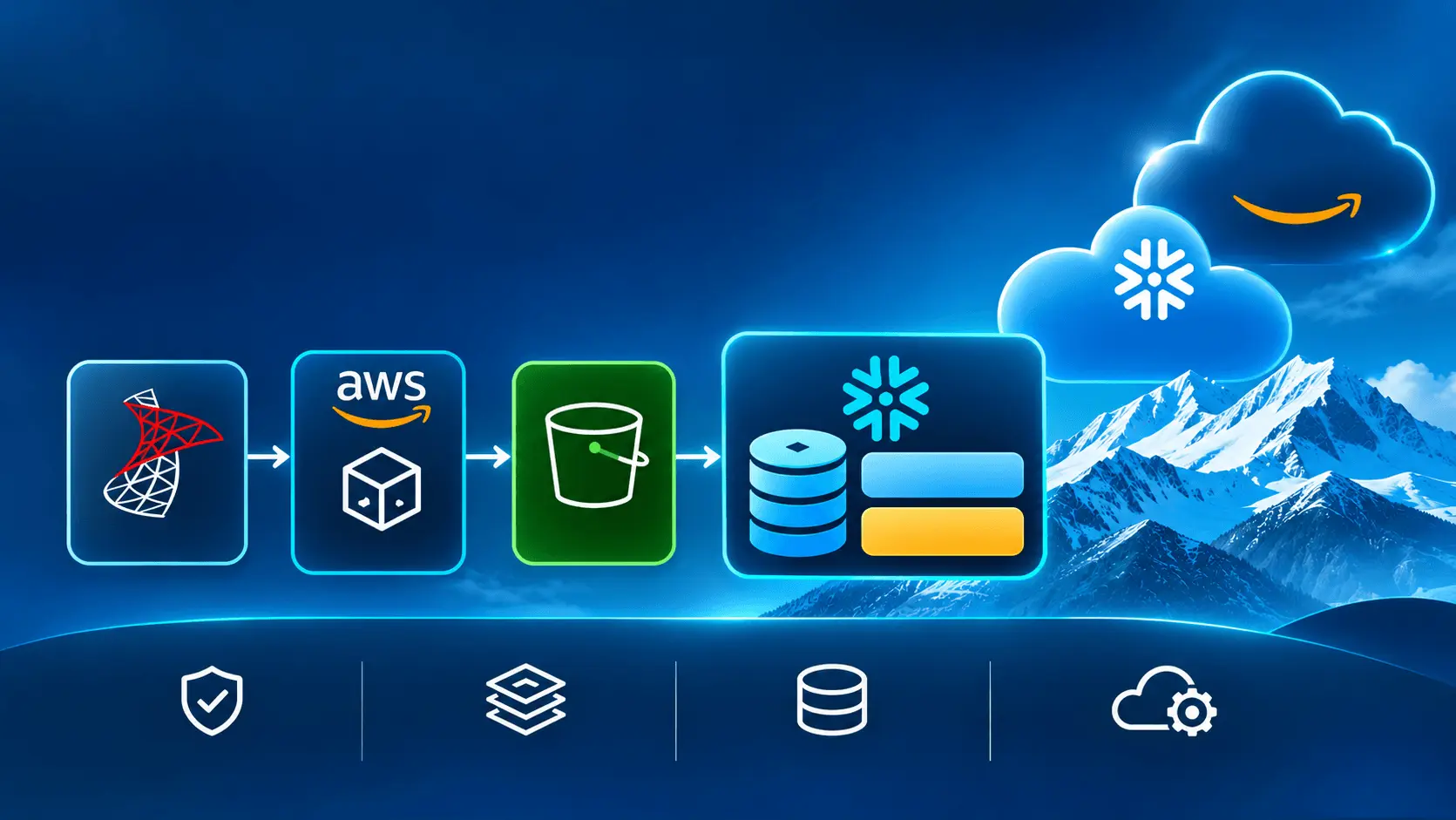
This series is a field guide to getting it right, using a pattern we deploy often: transactional SQL Server sources, an S3-based data lake, and Snowflake as the analytical engine, orchestrated on AWS. The specifics are concrete. The principles apply to almost any source and any engine.
What we believe
These principles shape every design decision in the series. They are also the standard we hold our own work to.
- Correctness first, then freshness, then cost, in that order. A fast, cheap pipeline that occasionally loses rows has negative value, because it teaches the business to stop trusting data. We design for provable completeness first, then reduce latency, then optimise spend. Teams that reverse this order spend the savings on reconciliation.
- Object storage is the system of record. Compute is disposable. Every extracted change lands in S3 as open-format files before any engine touches it. That landing zone is an immutable, replayable history of the business. Warehouses, clusters and models can be rebuilt from it, swapped out, or run side by side. This is what keeps architectural options open, and it is the foundation of any credible lakehouse strategy.
- Every step must be idempotent and replayable. Pipelines fail. Networks drop, credentials expire, sources spike. The question is not whether a run will fail but whether re-running it is safe. Watermarks advance only after data is durable; merges only apply newer versions; loads track which files they have consumed. Recovery becomes “run it again”, not an incident bridge.
- The source system is a customer too. Extraction that degrades the transactional database it reads from is a production incident waiting for a busy day. Index-backed, chunked, non-blocking reads are not an optimisation; they are a condition of being allowed to read from production at all, and they are what make hourly or near-real-time freshness possible.
- Transformation belongs where the data lives, in versioned code. Python and containers are excellent at moving bytes. Business logic belongs in set-based SQL running inside the engine, managed in dbt with code review, tests and lineage. Logic that lives in an ETL tool’s GUI or a sprawling script is logic nobody can audit.
- Security is identity, not secrets. No access keys in code, images or SQL. Workloads assume IAM roles; Snowflake reaches S3 through storage integrations; service users authenticate with key pairs; remaining secrets live in AWS Secrets Manager. A pipeline whose credentials can be copied out of a repository is not production-ready, however well it performs.
- Pay for work, not for waiting. Containers run on Fargate only for the minutes they work. Warehouses auto-suspend. Transformation runs only when extraction produced something new. Cost efficiency comes from the architecture, not from quarterly clean-up exercises.
The reference architecture
The pattern in this series maps cleanly to the layered (“medallion”) model most data organisations now use, and to native AWS and Snowflake services:
| Layer | Purpose | Implementation | Article |
|---|---|---|---|
| Source | Operational truth | SQL Server with rowversion change detection | 2 |
| Extraction | Gap-free, non-intrusive change capture | Python on ECS Fargate; chunked, index-backed reads; MIN_ACTIVE_ROWVERSION() watermark | 2, 3, 5 |
| Bronze: landing zone | Immutable, replayable history in an open format | Compressed Parquet in S3, partitioned by table and load time | 4 |
| Silver: raw and conformed | Bulk-loaded, de-duplicated current state | Snowflake COPY INTO via storage integration; guarded MERGE / dbt incremental models | 4, 5 |
| Gold: products | Business-ready, tested, documented models | dbt models with tests and lineage | 5 |
| Control plane | Sequencing, identity, secrets, cost | EventBridge, ECS task roles, Secrets Manager, auto-suspend warehouses | 6 |
Two properties of this design are deliberate. First, the bronze layer is engine-neutral: the same Parquet history can feed Snowflake today, other engines tomorrow, and machine learning workloads in parallel. Second, every arrow in the flow is idempotent, so any layer can be rebuilt from the one before it.
Build, buy, or both
A mature architecture practice starts by asking whether to build at all. The hand-built pattern in this series is the right choice in some situations and not in others.
Managed replication (AWS Database Migration Service, commercial ELT connectors, or SQL Server’s native Change Data Capture feeding a managed service) is often the better choice when you have many standard sources, a small engineering team, and need deletes and schema changes handled for you. You trade per-row or per-connector cost and some control for speed of delivery.
The pattern in this series earns its place when tables are very large and connector pricing scales badly, when you need precise control over load placed on fragile production databases, when regulatory or residency requirements demand that data never leaves your own AWS accounts, or when the team wants ingestion it fully understands and can debug at 2 a.m.
Most organisations end up with both: managed connectors for the long tail of SaaS and standard sources, and an engineered path for the handful of large, business-critical systems where correctness and cost matter most. The principles above apply to both. Whichever you choose, verify completeness yourself; a vendor’s green status light is not reconciliation.
How the series maps to the AWS Well-Architected Framework
| Pillar | Where the series addresses it |
|---|---|
| Reliability | Gap-free watermarks, idempotent loads, replay from the landing zone (Articles 2, 4, 5) |
| Performance efficiency | Index-backed chunked extraction; bulk loading instead of row-by-row inserts (Articles 3, 4) |
| Security | IAM task roles, storage integrations, Secrets Manager, key-pair authentication (Articles 4, 6) |
| Cost optimisation | Fargate, transient staging, auto-suspend, skip-if-empty orchestration (Articles 4, 6) |
| Operational excellence | Fail-fast sequencing, dbt tests, alerting, reproducible container images (Articles 5, 6) |
| Sustainability | Compute that runs only when there is work to do (Article 6) |
An ingestion maturity model
Most organisations we meet sit at level 2. The series is a path to level 4.
| Level | Characteristics | Typical symptom |
|---|---|---|
| 1. Reload | Full truncate-and-load on fixed schedules | Overnight windows that keep growing; data a day old |
| 2. Timestamp | Incremental loads on a LastModifiedDate column; separate cron schedules | Unexplained gaps between source and warehouse; empty runs that still cost money |
| 3. Engineered | Gap-free watermarks, chunked extraction, de-duplicating merges, defined delete strategy | Reliable data, but recovery and changes still depend on a few individuals |
| 4. Productised | Replayable lake, idempotent and event-driven runs, tested models, reconciliation and freshness monitoring, identity-based security | Data teams spend their time on new data products, not on explaining old numbers |
The series
- Your Data Warehouse Is Only as Good as Your Incremental Load — the business case, for the leaders who own the outcome.
- The Silent Data Loss Bug in Incremental ETL — why the obvious watermark loses data, and the precise fix.
- Extracting Changes from Billion-Row Tables Without Slowing Production — making extraction invisible to the source.
- Loading SQL Server Changes into Snowflake the Right Way — the landing zone, bulk loading and merges that cannot regress.
- Python Extracts, dbt Transforms — a clean division of labour between movement and modelling.
- From Cron Jobs to Containers: Running Data Pipelines on AWS — sequencing, packaging and secure, pay-per-use operation.
Leaders can read Article 1 and this introduction for the strategic picture. Architects and engineering leads will get the most from Articles 2 to 6, each of which includes working code.
Looking ahead
Two shifts make these foundations more valuable, not less. Open table formats such as Apache Iceberg are letting Snowflake and other engines share the same data in your own S3 buckets, which rewards organisations that already treat object storage as the system of record. And AI workloads raise the cost of untrustworthy data: a model or agent built on a feed that silently drops rows will be confidently wrong at scale. In both cases, the advantage goes to teams whose ingestion is already correct, replayable and engine-neutral.
Work with us
YenDigital designs and delivers data lake and warehouse platforms on Snowflake and AWS, from architecture reviews and ingestion assessments to full builds handed over to your team. If you want an honest view of where your platform sits on the maturity model, and what it would take to move up a level, we’d welcome the conversation.